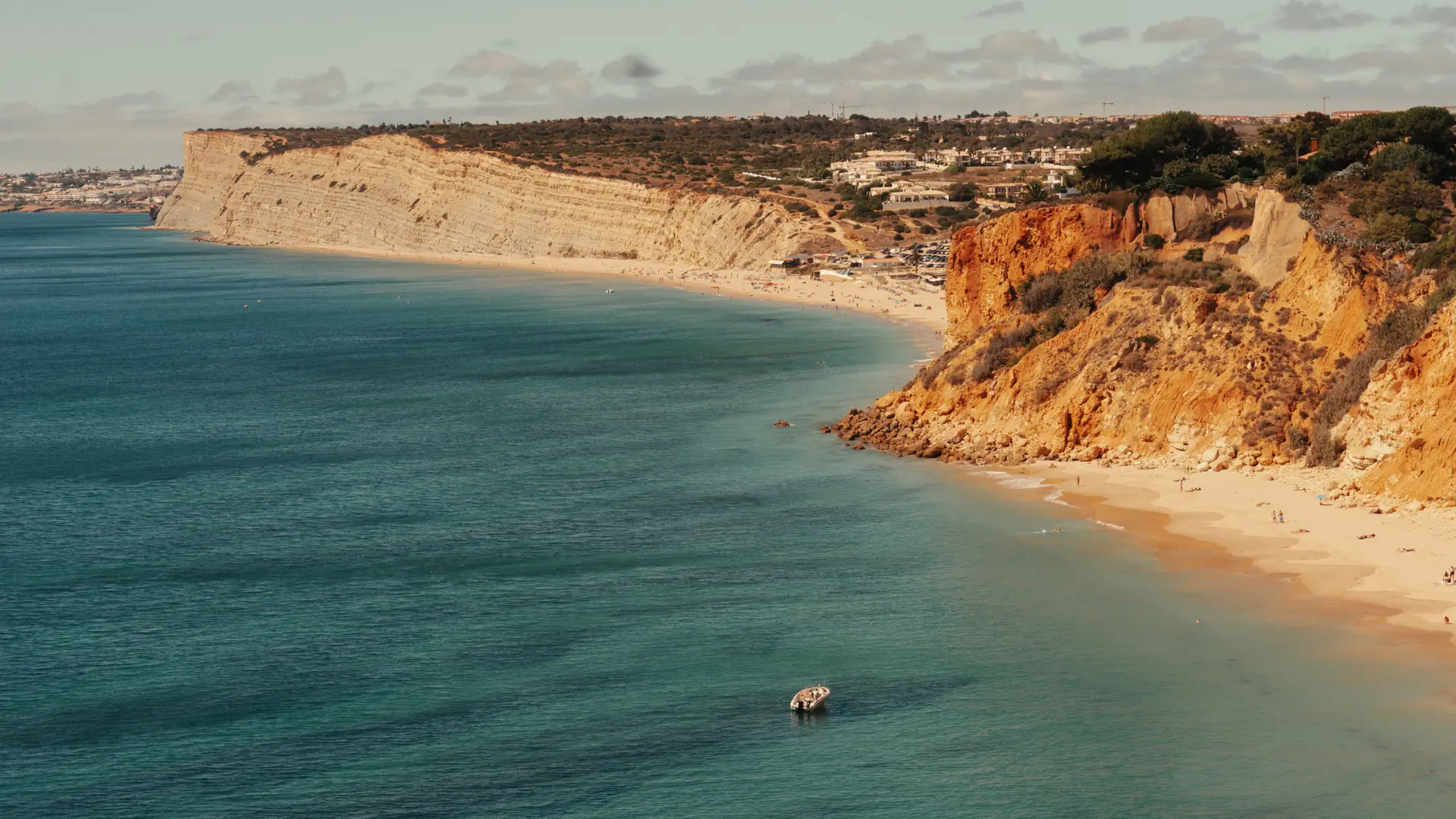
Sunlit dark rock cliffs and turquoise Atlantic waves along the Alentejo coast near Zambujeira do Mar

Rota Vicentina Fishermen's Trail in 6 days

One night each in five coastal villages, walking the Fishermen's Trail's original 75-kilometre stretch of Alentejo sea cliffs from Porto Covo to Odeceixe.

Duration
6 days, 5 nights
Bases
5 coastal villages
Main transport
On foot, with a daily luggage-transfer van
Best window
Sep-Jun; avoid August in Zambujeira
Finding current stays

Why this route walks the Fishermen's Trail's original, most complete stretch

The Fishermen's Trail is the coastal half of the wider Rota Vicentina network, and this six-day version covers its original, most-walked stretch: Porto Covo to Odeceixe, roughly 75 kilometres across four days, entirely inside the Southwest Alentejo and Vicentine Coast Natural Park. Each night lands in a different village along the way, from Porto Covo's working fishing harbour to Vila Nova de Milfontes' river-mouth energy, Almograve's near-empty quiet, Zambujeira do Mar's clifftop drama, and finally Odeceixe's split river-and-sea beach beneath nesting white storks. A daily luggage-transfer service removes the main obstacle to a trip like this, moving bags between guesthouses so each day's pack can stay light. None of the four walking days is technical, but two of them, Porto Covo to Vila Nova de Milfontes and Almograve to Zambujeira do Mar, run over 20 kilometres on sandy, largely shadeless clifftop paths, so this rewards a reasonable walking fitness rather than pure enthusiasm alone.

This is the coastal route, not the inland one

Unlike the Rota Vicentina's inland Historical Way, the Fishermen's Trail stays close enough to the sea cliffs for the Atlantic to stay in view for most of every stage, a genuinely different walking experience from the network's other route.

A daily luggage service removes the biggest trekking barrier

Vicentina Transfers moves luggage daily between villages along this exact stretch from February to November for about €15 a section, meaning this trip works with a day pack rather than a full multi-day trekking load.

The ending is a genuinely unusual wildlife sight, not just a beach

Praia de Odeceixe, this route's finishing point, is one of only a handful of places anywhere with white storks nesting directly on maritime cliffs, a detail that makes the final stage's ending more than just a scenic beach.

Best for

  • Hikers who want a genuinely coastal, cliff-and-dune trail rather than an inland walking route
  • Travellers comfortable with four days of 15-22 kilometre walking on sandy, largely shadeless terrain
  • Anyone who prefers a village-to-village trail with guesthouses and a luggage service over a fully self-supported trek

Think twice if

Anyone hoping to drive most of a coastal Portugal trip rather than walk it, or hikers unwilling to start early on the two longest, shadeless clifftop stages.

StartBooker answer

How do you walk the classic stretch of the Fishermen's Trail in six days?

Six days covers the Fishermen's Trail's original and most famous stretch: one night each in Porto Covo, Vila Nova de Milfontes, Almograve, Zambujeira do Mar and Odeceixe, walking roughly 75 kilometres across four hiking days inside the Southwest Alentejo and Vicentine Coast Natural Park. The trail runs close to sea cliffs on sandy paths rather than inland tracks, which is what separates it from the Rota Vicentina's other route, the Historical Way. A luggage-transfer service run by Vicentina Transfers moves bags between villages daily from February to November, so this works without carrying a full pack. September to June is the trail's usable season; wild camping is not permitted anywhere along it.

Route order
Porto Covo (1 night) → Vila Nova de Milfontes (1 night) → Almograve (1 night) → Zambujeira do Mar (1 night) → Odeceixe (1 night)
Total distance
About 75 km across four walking days, roughly 15-22 km per day
Protected status
Runs entirely inside the Southwest Alentejo and Vicentine Coast Natural Park
Luggage transfer
About €15 per one-section transfer, daily February to November, booked online

What each overnight village contributes

Each of the five villages gets one night, matching the trail's own stage structure; none is skipped or doubled up, since the point of this route is walking between them, not basing out of one town.

5 stops · swipe

  1. Sunny main square of Porto Covo with whitewashed blue-trimmed houses and palm trees 1

    Porto Covo

    1 night

    A working fishing harbour and the Roman-era ruins of Ilha do Pessegueiro just offshore

    One night in this working fishing village sets up the trail's first stage, with an afternoon free to walk out to Ilha do Pessegueiro's Roman ruins and 17th-century fort at low tide.

    Watch out: Ilha do Pessegueiro is only reachable on foot at low tide; check the tide table before planning the walk out, not after.

  2. Whitewashed steps climbing to the Forte de Sao Clemente above Vila Nova de Milfontes under a bright blue sky 2

    Vila Nova de Milfontes

    1 night

    The Rio Mira estuary, the Forte de São Clemente, and the trail's widest choice of restaurants

    The trail's largest and liveliest town, sitting where the Rio Mira reaches the Atlantic, with enough restaurants and rooms to make it the natural hub of this route.

    Watch out: The approach along low, largely shadeless cliffs from Porto Covo is the trail's second-longest day; start early rather than in the heat of midday.

  3. Green and blue Fishermen's Trail waymark painted on a rock along a sunlit sandy dune path near Almograve 3

    Almograve

    1 night

    The trail's shortest, quietest stretch and a beach village with genuinely fewer visitors

    The smallest overnight stop on this route, Almograve trades restaurant choice for a genuinely quieter stretch of coastline than the towns either side of it.

    Watch out: Confirm a dinner reservation or plan for limited options on arrival, since the village's restaurant count is small outside peak summer.

  4. Zambujeira do Mar perched on high sea cliffs above the Atlantic in warm afternoon light 4

    Zambujeira do Mar

    1 night

    High clifftop scenery, a clifftop beach setting, and an August world-music festival

    Perched directly above its own beach on high sea cliffs, Zambujeira do Mar caps the trail's longest, most dramatic walking day with the most exposed setting of any stop on this route.

    Watch out: Avoid the village entirely during its August world-music festival week unless attending it on purpose; every room for miles books out.

  5. Wide sandy beach with a sea stack and cliffs under bright blue sky near Odeceixe 5

    Odeceixe

    1 night

    Praia de Odeceixe's split river-and-sea beach, and cliff-nesting white storks

    The trail's finishing point for this route, Odeceixe pairs a river-and-sea beach with one of the only places anywhere to see white storks nesting on maritime cliffs.

    Watch out: There is no train from Odeceixe; arrange a taxi, rental car, or regional bus for the return journey before finishing the trail, not after.

Six days, four walking stages, from a fishing harbour to a stork-nested beach

Four walking days sit between an arrival day in Porto Covo and a closing morning in Odeceixe; each day's distance and timing below follows the trail operator’s stage data reviewed on 9 September 2026, and assumes a moderate pace with stops for photos and food, not a race.

1 Day 1 Settle into Porto Covo and the Roman ruins of Ilha do Pessegueiro

Settle into Porto Covo, a small fishing village inside Sines municipality that still functions as a working harbour rather than a resort built purely for tourism. Spend the afternoon walking out to Ilha do Pessegueiro, a small island just offshore reachable at low tide, where Carthaginian and Roman remains, including a fish-processing centre and salt tanks excavated in the 1980s, sit beside a star-shaped 17th-century fort. Use the evening to repack for the trail: the Fishermen's Trail runs on sand and low dunes rather than pavement, so trail shoes rather than boots are the common choice, and a first walking day of over 20 kilometres tomorrow rewards an early night.

  • Settle into Porto Covo, a working fishing village rather than a purpose-built resort
  • Walk out to Ilha do Pessegueiro at low tide to see Roman-era ruins and a 17th-century fort
  • Repack for sandy, dune-based trail walking rather than paved paths
  • Get an early night before tomorrow's longest early stage

Overnight: Porto Covo

2 Day 2 Porto Covo to Vila Nova de Milfontes: the trail's busiest stage

The trail's second stage runs about 20 kilometres from Porto Covo to Vila Nova de Milfontes, closely following low cliffs above small coves for most of the route with few shade options, so an early start matters more here than on any later day. Vila Nova de Milfontes itself sits where the Rio Mira meets the Atlantic, and it is the largest and liveliest town on this whole stretch, with a working fishing harbour, the small Forte de São Clemente overlooking the river mouth, and enough restaurants to make it worth arriving with some afternoon left rather than pushing straight to a room.

  • Walk the roughly 20-kilometre cliff-top stage from Porto Covo to Vila Nova de Milfontes
  • Start early, since this stage has little shade along the low coastal cliffs
  • Arrive at the Rio Mira estuary, where Vila Nova de Milfontes is the trail's largest town
  • See the Forte de São Clemente overlooking the river mouth before dinner

Overnight: Vila Nova de Milfontes

3 Day 3 Vila Nova de Milfontes to Almograve: the trail's quietest stage

Cross the Rio Mira by the road bridge upstream, since there is no ferry on the trail itself, before rejoining the coast path for the roughly 15-kilometre stage to Almograve, the shortest and quietest walking day of the trip. The cliffs here run lower and the trail passes fewer villages, giving a genuinely emptier stretch of coastline than the day before. Almograve itself is little more than a village behind its own beach, with a noticeably smaller choice of rooms and restaurants than either town on either side of it, so confirm dinner plans on arrival rather than assuming a wide choice.

  • Cross the Rio Mira by the road bridge before rejoining the coastal trail
  • Walk the shortest and quietest stage of the trip, about 15 kilometres to Almograve
  • Notice the emptier, lower-cliff coastline compared with the previous day
  • Confirm dinner in Almograve on arrival, since options are genuinely limited

Overnight: Almograve

4 Day 4 Almograve to Zambujeira do Mar: the trip's longest, highest stage

This is the longest walking day of the trip, roughly 22 kilometres to Zambujeira do Mar, and also the one with the most dramatic scenery: the trail climbs onto genuinely high sea cliffs for long stretches, with the Atlantic visible on one side the entire way. Zambujeira do Mar itself sits directly above its own beach on a clifftop rather than beside a river mouth like Vila Nova de Milfontes, giving it a different, more exposed feel; the village hosts a well-known world-music festival in August that fills every room for miles, so avoid that week entirely unless attending on purpose.

  • Walk the trip's longest stage, about 22 kilometres, onto genuinely high sea cliffs
  • Keep the Atlantic in view for nearly the entire day's walk
  • Arrive at Zambujeira do Mar, perched directly above its own clifftop beach
  • Avoid the August world-music festival week unless attending it on purpose

Overnight: Zambujeira do Mar

5 Day 5 Zambujeira do Mar to Odeceixe: finishing at the river-and-sea beach

The final stage runs about 18 kilometres from Zambujeira do Mar to Odeceixe, crossing out of Odemira municipality into Aljezur, and ends at one of the trail's genuine landmarks: Praia de Odeceixe, a beach split by the Ribeira de Seixe into a calm river-bathing side and an open sea-bathing side, one of only a handful of places anywhere with white storks nesting on the maritime cliffs above the water. Walk the last stretch down from the village to the beach itself before finishing, rather than treating the village as the actual endpoint; it is the single most photographed spot on this whole stretch of trail for good reason.

  • Walk the final roughly 18-kilometre stage from Zambujeira do Mar into Aljezur municipality
  • Finish at Praia de Odeceixe, split by a river on one side and the open sea on the other
  • Look for white storks nesting on the maritime cliffs above the beach, a rare sight worldwide
  • Walk down to the beach itself as the real finish, not just the village above it

Overnight: Odeceixe

6 Day 6 Departure day: a last morning at Praia de Odeceixe

Use the morning for a second, unhurried look at Praia de Odeceixe before arranging the return trip; there is no train on this stretch of coast, so onward travel means a pre-booked taxi, a rental car left ready at the start, or the regional bus toward Lisbon or Faro. Travellers with a couple more days free can keep walking the same trail south into the Algarve toward Arrifana and Sagres, since the Fishermen's Trail itself does not end at Odeceixe, this itinerary simply does.

  • Return to Praia de Odeceixe for an unhurried final morning
  • Arrange a pre-booked taxi, rental car, or regional bus, since there is no train here
  • Note that the Fishermen's Trail itself continues south toward Arrifana and Sagres
  • Treat Odeceixe as this itinerary's endpoint, not the trail's actual end

Overnight: Odeceixe

Four walking stages, each closer to 20 km than 10

Four walking stages link the five villages, entirely on foot along the coast; the only wheeled options anywhere on this stretch are the luggage-transfer van and, at the very start and end, a taxi or rental car to reach the trailhead.

4 transfers

  1. Porto Covo Vila Nova de Milfontes

    On foot Travel time: About 20 km, 6-7 hours walking

    This stage runs closest to the sea of any on the route, following low cliffs above small coves for most of its length with very little shade. It is also the day most first-time hikers underestimate, since the sandy trail surface is noticeably more tiring underfoot than a paved or packed-earth path of the same distance.

    Booking note: Book the Vicentina Transfers luggage pickup from Porto Covo the evening before; the service collects from about 9:00am.

  2. Vila Nova de Milfontes Almograve

    On foot Travel time: About 15 km, 5-5.5 hours walking

    The stage opens with crossing the Rio Mira on the road bridge upstream from Vila Nova de Milfontes, then rejoins the coast for a noticeably quieter, lower-cliff stretch than the day before. It is the shortest walking day of the trip and a fair recovery day after the longer opening stage.

    Booking note: Confirm the Almograve luggage drop-off time with Vicentina Transfers, since the village's guesthouses are smaller and may have narrower check-in windows than the larger towns.

  3. Almograve Zambujeira do Mar

    On foot Travel time: About 22 km, 6-6.5 hours walking

    The longest stage of the route climbs onto genuinely high sea cliffs for extended stretches, with almost constant Atlantic views and correspondingly little shelter from sun or wind. Treat this as the day to start earliest and carry the most water.

    Booking note: Book this section's luggage transfer as part of a multi-section booking if possible; Vicentina Transfers offers a lower per-section rate for bookings of three or more transfers.

  4. Zambujeira do Mar Odeceixe

    On foot Travel time: About 18 km, 5-5.5 hours walking

    The final stage crosses out of Odemira municipality into Aljezur, with the trail's character shifting subtly as it approaches the Ribeira de Seixe river valley before dropping to Praia de Odeceixe. This is a fitting stage to finish on rather than the hardest of the four.

    Booking note: Arrange onward transport from Odeceixe before finishing this stage; there is no train station, and same-day taxi availability is limited in a village this size.

Trail conditions, seasonal closures for erosion or fire risk, and the luggage-transfer schedule can change; always confirm current stage status on rotavicentina.com before setting out.

Real costs and what to book ahead on the Fishermen's Trail

There is no trail fee, and the natural park itself charges nothing to walk through it, so this trip's real cost sits in accommodation, the luggage-transfer service, and meals rather than any ticket. Vicentina Transfers prices a single-section bag transfer at about €15 including one piece of luggage, with rates dropping per section on longer multi-day bookings. Rooms in the two established beach towns, Vila Nova de Milfontes and Zambujeira do Mar, generally cost more than in the smaller villages either side; treat any figure here as a planning range rather than a live quote.

Vicentina Transfers, one bag per section Covers Santiago do Cacém to Lagos daily from February to November; luggage must be ready by 9:00am and is delivered by 4:30pm the same day.
About €15 per section; verify live
Accommodation average nightly rate Vila Nova de Milfontes and Zambujeira do Mar run higher than Porto Covo, Almograve or Odeceixe; test the intended nights in the hotel search above.
Plan €60-€150 per room; verify live
Daily meals along the trail A flexible allowance. Villages between the two main towns have fewer restaurant choices, so a packed lunch on the longer walking days is common practice.
€25-€45 per person daily
Return transport from Odeceixe No train serves this coast; arrange a taxi, rental-car drop-off, or the regional bus back to Lisbon or Faro before setting out.
Plan €20-€60 depending on the option chosen; verify live

Booking tips

  • Book Vicentina Transfers online once accommodation for every night is confirmed; the service covers the whole Santiago do Cacém-to-Lagos stretch daily from February to November, but slots for peak spring weekends still fill ahead.
  • Reserve rooms in Vila Nova de Milfontes and Zambujeira do Mar earliest of the five stops, since both are established beach towns with more demand from non-hikers than the smaller villages either side.
  • Confirm which restaurants are open in Almograve before arrival; it is the smallest overnight stop on this route and can have thinner dinner options outside the summer season.
  • Walk south to north if avoiding crowds matters more than finishing at a specific point, since most guided groups and independent hikers move north to south along this stretch.

Where to stay in Vila Nova de Milfontes

Book the Vila Nova de Milfontes night near the Rio Mira estuary, the trail's largest town and the easiest base to reach if arranging transport before or after the walking days.

Search all Vila Nova de Milfontes stays →
Finding top Vila Nova de Milfontes accommodations...

Fishermen's Trail route map

See the full walking route from Porto Covo through Vila Nova de Milfontes, Almograve and Zambujeira do Mar to Odeceixe, with each stage's verified stop coordinates plotted along the coast.

Vila Nova de Milfontes

Questions about hiking the Fishermen's Trail from Porto Covo

What is the classic Porto Covo to Odeceixe stretch of the Fishermen's Trail?

Walk south to north or north to south from Porto Covo to Odeceixe across four stages: Porto Covo to Vila Nova de Milfontes, then to Almograve, then to Zambujeira do Mar, then to Odeceixe, adding an arrival night in Porto Covo and a closing morning in Odeceixe. This 75-kilometre stretch is the original, most-walked section of the wider 226-kilometre Fishermen's Trail, and it does not require continuing further south toward Aljezur or Sagres to feel complete.

Do you need a car to hike this stretch of the Fishermen's Trail?

No car is needed for the walking itself, since the trail runs between five villages that each have accommodation and the Vicentina Transfers service moves luggage between them daily. A car, taxi, or the regional bus is needed only at the two ends: getting to Porto Covo at the start and leaving Odeceixe at the end, since neither village has a train station.

Which day of this Fishermen's Trail route is the hardest?

Almograve to Zambujeira do Mar, at roughly 22 kilometres with long exposed clifftop stretches, is the longest and most demanding day on this route. Porto Covo to Vila Nova de Milfontes runs close behind at about 20 kilometres with similarly little shade. Both are manageable in a single day for anyone who walks regularly, but neither should be the first long walk of an unconditioned trip.

When should you plan a Fishermen's Trail hike?

September to June is the trail's usable season, since the Rota Vicentina association itself designed the stage system around avoiding the hottest, most exposed summer months on largely shadeless clifftop paths. Late spring, especially April and May, adds wildflowers along the dune sections; avoid the first weekend of August specifically, when Zambujeira do Mar's music festival fills every room on this stretch of coast.

Can you camp along this section of the Fishermen's Trail?

No; wild camping is not permitted anywhere along the Rota Vicentina network, including this stretch, and the trail's own stage system was designed around overnighting in the five villages it passes through rather than camping between them. Established campsites exist in some of these villages for anyone who prefers that over a guesthouse room.

How would you continue this hike past Odeceixe?

Continue past Odeceixe into the Algarve side of the same Fishermen's Trail, toward Arrifana and on to Cabo de São Vicente near Sagres, rather than treating this six-day version as the trail's actual end point. That stretch adds two to three more walking days and crosses from the Alentejo coast into the Algarve's own cliff scenery, a genuinely different landscape from the dune-and-clifftop coast covered here.

Sources and editorial review

Reviewed by StartBooker editorial Fishermen's Trail route planning and editorial research

Last reviewed 2026-09-09

How this itinerary was researched and verified: Eleven direct source records across ten publishers were reviewed. The Rota Vicentina association's own trail pages supplied stage structure and rules directly; Vicentina Transfers supplied luggage-service pricing and scheduling; the ICNF supplied the natural park's protected status; the Odemira and Aljezur municipal tourism sites supplied town and beach facts for their respective stops. Independent hiking-focused sources were used to cross-check stage distances and walking times, not as prose templates, since the official trail pages describe stages qualitatively rather than always giving exact kilometre figures.

11 references reviewed

Key primary sources
  • Associação Rota Vicentina
  • Vicentina Transfers
  • Instituto da Conservação da Natureza e das Florestas
  • Câmara Municipal de Odemira
  • Município de Aljezur
  • Turismo de Portugal
Photo credits

Have you walked this section of the Fishermen's Trail?

Which of the four walking days felt the longest, and did the distance match what you expected?