Sorrento is a launchpad, not a detour
Its direct Circumvesuviana connection to Naples and its position at the start of the SITA bus network make Sorrento the base that absorbs arrival fatigue and keeps Capri optional rather than mandatory.
Three coastal bases, linked by buses and seasonal ferries. Plan around crowded roads.
Sorrento, Positano and Amalfi sit close together on a map, and a rental-car ad or an influencer reel will happily suggest driving all three in an afternoon. Do not plan around that image. The SS163 coastal road that links them is narrow, cliff-hung and shared with local buses, delivery vans, scooters and every other visitor's rental car; in July and August it can take longer to cover twenty kilometres by road than it took to fly into Naples. This itinerary answers that constraint directly by giving each base its own two nights and by moving between them on a SITA bus or, in season, a ferry that skips the traffic entirely.
Sorrento earns its slot as the arrival base because it sits on a direct, cheap and frequent rail line from Naples, has enough hotel capacity to be bookable without months of notice, and puts Capri within a short, if weather-dependent, boat ride. Positano is the coast's most photographed town and the fairest place to spend a genuinely idle beach-and-boutique day, but its steps and its port both fill up fast, so this plan treats it as a base rather than a rushed stop. Amalfi is the practical and historic anchor of the coast that shares its name: a working town with a cathedral, a real ferry dock, and the SITA bus connection up to Ravello's gardens.
The honest trade-off is seasonal. Ferries, which are the calmest and often quickest way to move along the coast, run only from around mid-April to mid-October and can be cancelled for wind even when the sea looks fine from the shore. Outside that window, or when the sea says no, the SITA bus is the only option, and it needs patience rather than a fixed schedule fantasy. Build slack into every transfer day, do not book a dinner reservation immediately after a bus or boat, and accept that the coast rewards travellers who plan around its logistics rather than despite them.
Its direct Circumvesuviana connection to Naples and its position at the start of the SITA bus network make Sorrento the base that absorbs arrival fatigue and keeps Capri optional rather than mandatory.
Two nights let you use the town outside the cruise-crowd hours: an early beach walk, a late boat, and enough time to accept that every errand here involves stairs.
Amalfi's cathedral square and Ravello's clifftop gardens are a twenty-minute bus ride apart, so basing in Amalfi lets you treat Ravello as an easy half-day rather than its own overnight.
Best for
Think twice if
Anyone planning to rent a car and self-drive the coast road in July or August, or a traveller who wants Naples, Pompeii, Capri and the full coast crammed into one week without dropping something else.
StartBooker answer
Fly or train into Naples, take the Circumvesuviana to Sorrento for two nights, then move to Positano for two nights and Amalfi for two nights, connecting each leg by SITA bus or, from April to October, a faster and calmer ferry. Treat Capri as a weather-dependent day trip from Sorrento rather than a guaranteed stop, and give the Path of the Gods hike its own day rather than squeezing it between transfers. The coast road carries all of this traffic on one lane in each direction, so a plan that assumes an on-time bus in August is the plan that breaks first.
Each base earns its nights by solving a specific problem: arrival logistics, an idle coastal stay, and the historic-town-plus-hillside-garden pairing.
3 stops · swipe
1
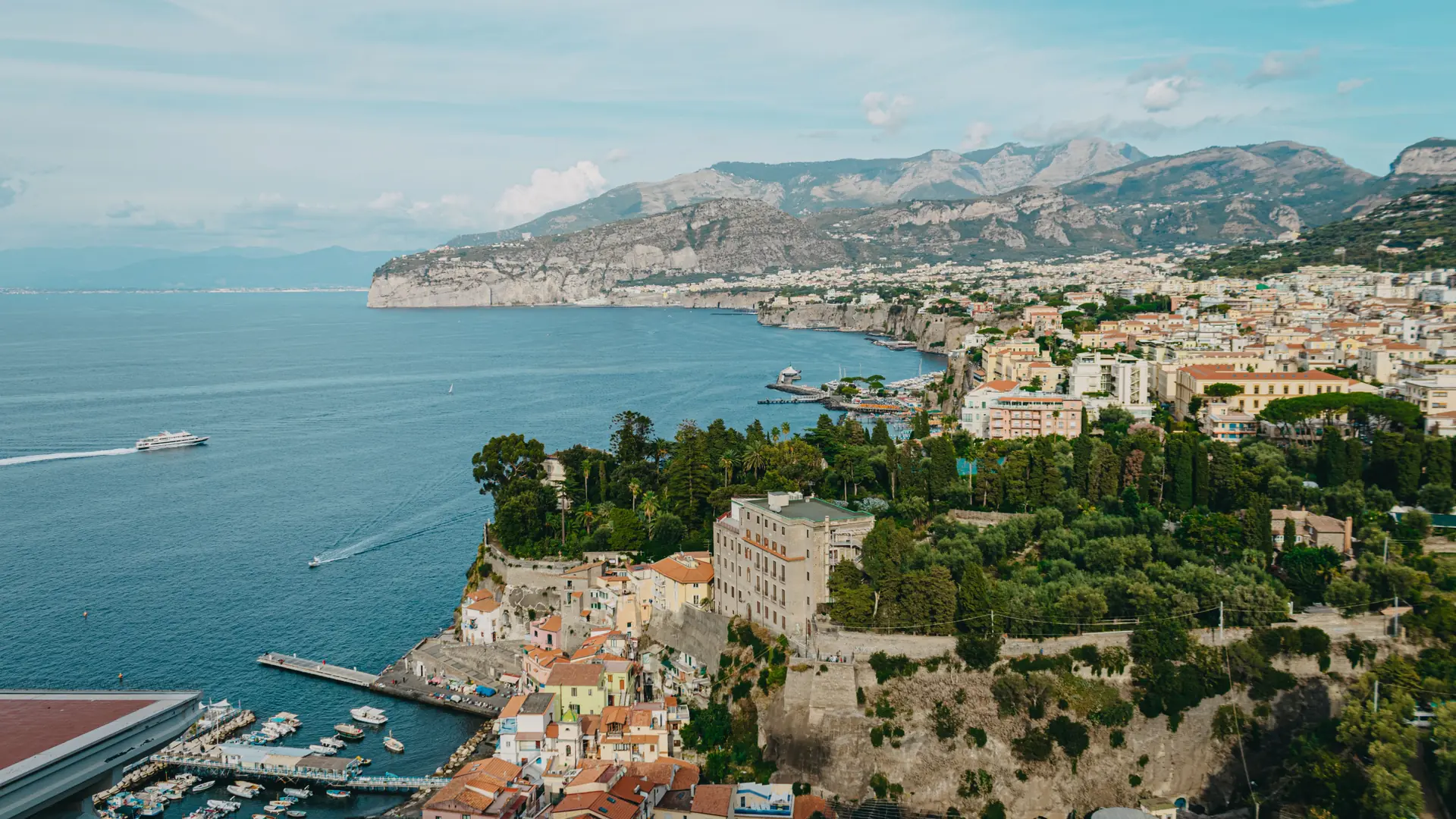
A direct rail link to Naples, clifftop views over the bay, and the easiest jump-off point for Capri
Sorrento is the coast's practical front door: flat enough to wheel a suitcase, connected to Naples by a cheap and frequent train, and close enough to Capri that a fair-weather day trip does not cost you a whole base change. Use the first night to recover from arrival and the second to decide, based on the actual forecast, whether Capri or the town itself is the better use of the day.
Watch out: The Circumvesuviana has no luggage space and can be crowded standing-room only; keep bags light for this leg and double-check the platform, since Sorrento and Sarno trains share a similar departure board.
2
Pastel houses stacked into a cliff, a small beach, and the coast's busiest port in summer
Positano is built on a slope steep enough that a hotel's true walking distance rarely matches its map distance. Two nights buy you a quiet early beach hour before the day-trip boats arrive and a later dinner once they leave, plus enough margin to take the SITA bus to the Path of the Gods trailhead without treating it as a same-day arrival activity.
Watch out: Book accommodation by its stair count and porter service, not only its view; a cheap room near the top of town can mean a genuinely demanding climb with luggage.
3
The striped cathedral of Sant'Andrea, a working ferry dock, and the bus gateway to Ravello
Amalfi is flatter and more workaday than Positano, which makes it the more comfortable final base with luggage. Its own historic centre deserves an afternoon, and its SITA bus connection turns Ravello's hilltop gardens into an easy half-day rather than a full relocation.
Watch out: Amalfi's ferry dock and bus stop both sit on the same small waterfront square, which gets genuinely congested at midday in peak season; build in extra time before any timed departure.
Every base-to-base move gets its own half-day rather than sharing a slot with sightseeing, because on this coast the transfer is often the least predictable part of the plan.
Land or arrive by train in Naples and take the Circumvesuviana directly to Sorrento; it is the cheapest connection on the coast, though the carriages are basic, unfussy commuter stock with no dedicated luggage racks and no air conditioning, so a lighter bag makes the roughly ninety-minute ride considerably easier. Confirm on the departure board that you are boarding a Sorrento-bound service rather than one terminating at Sarno, since both appear on the same platform pattern. Once you reach the hotel, keep the evening modest: a walk to Piazza Tasso or the clifftop gardens above the marina is enough to get oriented without fighting jet lag or a full suitcase. Use this time to check tomorrow's sea and weather forecast, since it decides whether Capri is realistically on the table.
Overnight: Sorrento
Make this a weather call, not a fixed booking made weeks in advance. If conditions are calm, take an early ferry to Capri: the crossing is short, but the island rewards an early start before the midday crowds arrive around the Piazzetta and the funicular queue. If the sea is rough or the forecast is unreliable, do not gamble a full day on a cancelled sailing; stay in Sorrento instead and use the day for the historic centre, the lemon-grove terraces above the marina, or a slower lunch than yesterday allowed. Neither option is a downgrade. The point of building this as a flexible day, rather than a fixed Capri booking, is that the rest of the week does not absorb a cancelled-ferry problem later, when you are trying to reach Positano on schedule instead.
Overnight: Sorrento
Travel to Positano by SITA bus, boarding at Sorrento's train station where seats are easier to find before the route fills along the way, or by seasonal ferry if the sailing times suit your morning and the sea is calm. Both options share the same rule: arrive at the stop or dock with real margin, since buses along the SS163 fill quickly and ferries can sell out in high season. Once you reach Positano, drop your bags and resist the instinct to sightsee immediately; the town rewards a slower approach. Spend the afternoon on the beach, along Via Positanesi d'America toward Fornillo, or simply finding the quickest legal route between your hotel and the centre, since you will retrace it daily. Save the church of Santa Maria Assunta and its majolica dome for early evening light rather than midday crowds.
Overnight: Positano
This is the itinerary's other flexible day, and it should be treated with the same honesty as the Capri call. The Path of the Gods, the coast's best-known ridge trail, is usually walked from Bomerano or Agerola down toward Nocelle and Positano; reach the trailhead by an early SITA bus, since the walk itself takes several hours over uneven, exposed terrain with real elevation change and very little shade. Start early to avoid the worst heat and to have daylight margin if the descent runs long. If the forecast is poor, if anyone in your group has knee or heat concerns, or if you would simply rather not spend a coast day inland, do not force it. A slower alternative, a boat trip along the coastline from Positano's port or a return visit to a beach you liked yesterday, is not a lesser use of the day; the hike is worthwhile only when you can do it without turning the rest of the trip into recovery time.
Overnight: Positano
Cover the short hop to Amalfi by ferry if it is running and the sea cooperates; the crossing is brief and spares you the same crowded bus you may have already used twice this week. If ferries are not operating, the SITA bus covers the same route, just more slowly and with the same summer congestion as every other leg. On arrival, drop bags first, since Amalfi's flatter streets still involve some genuine stairs near a hillside hotel. Spend the afternoon around the Duomo di Sant'Andrea and its cloister, then follow the narrow Valle dei Mulini inland a short distance if you want a quieter contrast to the waterfront. Amalfi's centre is compact enough to see without a rigid schedule, which makes it a good place to simply wander once the bags are settled.
Overnight: Amalfi
Take the SITA bus up from Amalfi's waterfront to Ravello, a climb of only about twenty minutes that trades sea level for clifftop views over the whole gulf. Villa Rufolo's gardens, the venue for the town's summer festival, do not require advance booking and reward even a modest visit with some of the coast's best framed views; Villa Cimbrone's cliffside terrace, a short walk further into town, is the other classic stop if you have the energy for both. Because Ravello sits so close to Amalfi, this does not need to be an all-day expedition: a late morning up, several hours among the gardens and the town's quiet lanes, and a return in time for a proper Amalfi dinner is a realistic, unhurried plan rather than a rushed add-on.
Overnight: Amalfi
Use the final morning for one small, low-effort choice: a last walk along Amalfi's waterfront, a coffee near the cathedral steps, or packing time if last night ran late. Then begin the journey out with the connection already checked rather than assumed: a SITA bus or ferry to Sorrento to rejoin the Circumvesuviana toward Naples, or, if the timing and budget work, a direct bus or transfer service toward Naples airport or Salerno's train station for onward high-speed rail. Whichever route you choose, do not schedule a flight or a fast train for the same window as your last coast transfer; this itinerary's whole premise is that connections here are frequent but rarely fast, and the final day is not the place to test that for the first time.
Base: Amalfi
Both moves between bases can run by SITA bus year-round or by ferry during the approximate April-to-October season; neither should be booked as a guaranteed fixed departure.
2 transfers
Sorrento Positano
The SITA bus from Sorrento's train station to Positano follows the coast road directly; in July and August, traffic on the single-lane SS163 can more than double the journey time. A seasonal ferry covers the same route by sea when it is running.
Booking note: Board at the Sorrento train station stop rather than further along the route, since buses fill and can pass full stops without stopping.
Positano Amalfi
This is the shortest coastal hop, and the ferry is usually the more pleasant option when it operates, skipping the bus's stop-and-go pattern through Praiano. Outside the ferry season, or when wind cancels sailings, the SITA bus is the only way through.
Booking note: Arrive at Positano's port at least 30 to 45 minutes before a summer sailing; the dock area gets crowded and boats can leave on a tight window.
Bus and ferry schedules, fares and seasonal operation change; check the current SITA SUD timetable and the relevant ferry operator close to travel rather than relying on a fixed departure time from an older source.
The real cost risk on this coast is not the fare itself, but a missed connection, a cancelled sailing, or a hotel with a punishing staircase you did not ask about.
Booking tips
The coast's most photographed base and its most demanding one for luggage: compare a clifftop view against a genuinely walkable stair count.
Use the map to compare an address near the port and beach against a quieter, steeper spot higher in town before you commit to a nightly staircase.
Positano
Yes, and most experienced visitors recommend it: parking is scarce, the coast road is narrow, and a self-driven rental adds stress rather than freedom. SITA buses and, in season, ferries connect every stop in this itinerary.
No. Treat it as a flexible Sorrento-day option that depends on sea conditions and ferry schedules, not a fixed booking. If the crossing is cancelled, Sorrento itself absorbs the day without disrupting the rest of the route.
Ferries, where they run, are usually calmer and often faster than the bus, especially in peak summer traffic, but they operate only during the roughly April-to-October operating season and can be cancelled for wind. Check both options on the day rather than assuming one is always available.
Yes if you are reasonably fit, start early, and are not also trying to relocate between bases that day. It is a genuine hike with real elevation and exposure, not a casual walk, so give it its own day and a fair-weather alternative.
Only by extending the trip. Both sit on the same Circumvesuviana line as Sorrento and can work as an extra day on arrival or departure, but adding them without extra nights means cutting time from Positano or Amalfi instead.
Late May, June or September balance reliable ferry service, warm but manageable weather, and lighter bus and hiking crowds better than the peak of July and August, when the coast road and the ports are at their most congested.
Reviewed by StartBooker editorial Amalfi Coast route and transport research
Last reviewed 2026-08-28
How this route was checked: The route was built around official municipal, rail and bus-operator sources for transport and access, with independent travel editors used only to check coverage and common traveller questions, not copied for phrasing. The Capri and Path of the Gods days are deliberately framed as weather-and-conditions decisions rather than fixed bookings, matching how these connections actually operate.
10 references reviewed
Photos provided by Pexels.
Did the bus or the ferry work better for your Positano–Amalfi leg?