Milan is a planned art opening
Use Milan’s first full day for the reservation you can lose: Last Supper availability. The Duomo terraces, Galleria and Brera then become flexible neighbours rather than competing morning appointments.
A two-night, two-night, two-night northern Italy rail route paced around Milan’s timed art, Verona’s historic core and Venice’s lagoon logistics.
This route is for a first northern Italy trip that wants three real cities, not three station photographs. Milan supplies the arrival gateway and the week’s least flexible reservation: Leonardo’s Last Supper is capacity-controlled, so its available slot should decide the order of the first full day. Verona is not a token stop between the fashionable capital and the lagoon. Two nights let you see the Roman Arena, walk the Adige and use its smaller scale as a break from Milan’s broad avenues and Venice’s bridge-heavy geography. Venice gets two nights because one night forces every decision into arrival and departure windows; two give you one landmark day and one slower canal or island day without pretending that the whole lagoon fits in a weekend.
The route works by rail because the main corridor links Milan, Verona and Venice directly. That does not make transfers invisible. Milan Centrale is a major station rather than the historic core, Verona Porta Nuova still needs a local connection or walk to your accommodation, and Venice Santa Lucia is on the island but not necessarily beside your hotel. In Venice, the final fifty minutes can involve bridges, a vaporetto and a restricted check-in window. Treat that as part of the price and accessibility calculation before choosing a room. A cheap island address with two boat changes is not automatically better value than a simpler arrival near a vaporetto stop.
Book the constraints in the right order. Confirm the Last Supper before committing to a Milan departure. In Verona, check the Arena’s current performance and visiting calendar rather than assuming a daytime monument visit will work on every date; make Juliet’s House optional unless the online slot actually suits the day. In Venice, choose a St Mark’s Basilica time before building an entire morning around the square, and check the municipal access portal for your dates rather than repeating a past season’s rule. The outcome is a route with room for lunch, rain, luggage and a missed turn, not a checklist that only survives if every train and queue behaves perfectly.
Use Milan’s first full day for the reservation you can lose: Last Supper availability. The Duomo terraces, Galleria and Brera then become flexible neighbours rather than competing morning appointments.
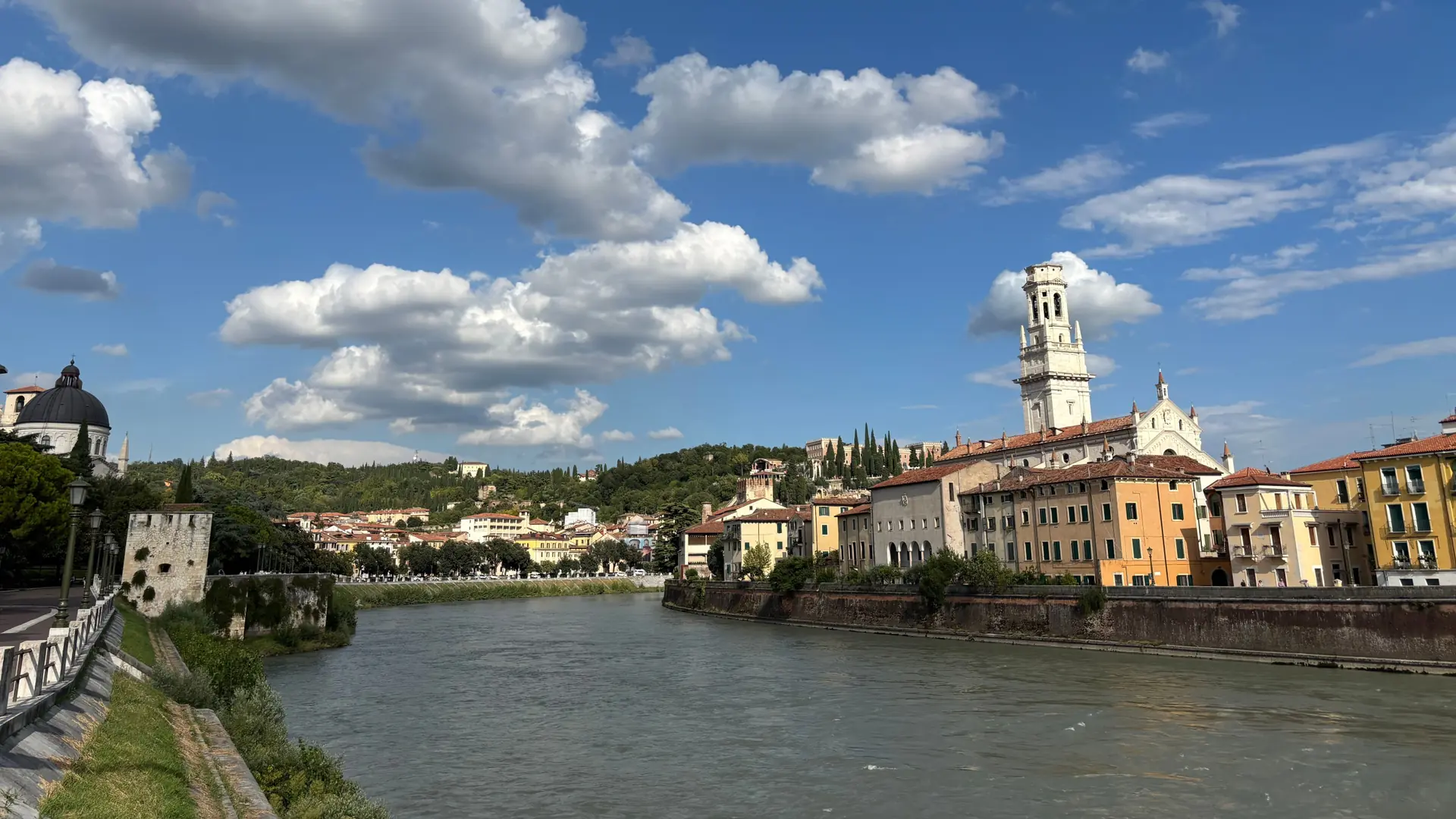
The Arena, river bends and car-light historic lanes make Verona a useful change of pace. Its location on the rail axis is an advantage, but the point of two nights is to avoid treating that advantage as a rushed layover.
Two island nights leave time for a booked St Mark’s visit, a practical vaporetto ride and a quieter walk away from the station-to-Rialto funnel. They do not promise every lagoon island.
Best for
Think twice if
A week that also adds Lake Garda, the Dolomites, Florence or Bologna. Each needs time; adding them turns Verona into a luggage stop and reduces Venice to a day trip.
StartBooker answer
Give each city two nights. Start in Milan, where a Last Supper reservation should set the first full day; move by train to Verona for the Arena, river walks and a deliberately optional Juliet’s House booking; then finish with two nights in Venice so the city is not reduced to a station-to-Saint-Mark’s dash. The rail corridor calls at Verona, so a car adds no useful flexibility. Reserve capacity-limited sights first, choose trains second, and check Venice access and vaporetto conditions with the current operators before travel.
The even split is intentional. Each stop has a different operational constraint, and none benefits from being reduced to a late-afternoon arrival followed by an early train.
3 stops · swipe
1
The Duomo, Leonardo’s Last Supper, La Scala and a working modern city centre
Milan is the route’s arrival base, but it is not merely a flight-recovery night. Give it a full day anchored by the Last Supper only after securing a slot; then use the Duomo complex, Galleria and Brera as a walkable set of choices. A second evening matters because an international arrival rarely produces a reliable museum morning.
Watch out: Do not build your Milan day around an assumed Last Supper ticket. The official visitor guidance says reservations are mandatory; choose an alternative art day when no slot exists.
Read the Milan guide →
2
A Roman amphitheatre, Adige river views, medieval lanes and the Arena opera season
Verona replaces the temptation to rush straight from Milan to Venice. One afternoon covers Piazza Bra and the Arena exterior; the extra day gives you time for Castelvecchio, Piazza delle Erbe, the river and a hill view without turning Juliet’s House into the only story. Its centre works well on foot once you have dealt with station luggage.
Watch out: Arena access and schedules change around performances. Juliet’s House is a booked museum visit, not a promise that you can walk in between coffee and lunch.
Read the Verona guide →
3
St Mark’s Basilica, vaporetto travel, canal-side neighbourhoods and lagoon islands
Venice is the finish because its after-hours streets are more useful once luggage is stored and the departure train is no longer today’s problem. Sleep on the island if bridges and a boat approach are manageable; otherwise choose mainland convenience honestly rather than calling it the same experience. One full day can serve St Mark’s and the Grand Canal, while the second can be Cannaregio, Dorsoduro or an island according to weather and energy.
Watch out: A vaporetto ticket and an airport transfer are not automatically the same product. Validate the route, luggage tolerance and airport inclusion with ACTV before deciding what pass represents value.
Read the Venice guide →Each day has one primary task. That leaves a practical margin for trains, hotel check-in, weather and the slower walking pace created by cobbles, bridges and crowds.
Land, reach the hotel and resist the urge to cross the city for a landmark before you know the arrival time. If energy allows, make a short Duomo-to-Galleria orientation walk, then choose dinner near the district where you are sleeping. The useful work tonight is administrative: check tomorrow’s Last Supper confirmation, understand the meeting and security instructions, and decide whether the Duomo or Brera is the fallback if weather or fatigue changes the day. Milan can feel spread out after a flight, particularly when a hotel near Centrale is chosen for rail convenience rather than a historic-centre evening. That is fine; treat the first night as a landing pad, not a failed sightseeing day.
Overnight: Milan
Start from the reservation rather than from a generic top-ten list. Arrive with the required margin for Leonardo’s Last Supper and let the confirmed time decide whether the Duomo terraces work better before or after it. The cathedral complex has its own ticket choices and changing visitor arrangements, so do not assume that a terrace climb belongs in every weather forecast or mobility profile. Between fixed visits, the Galleria is an easy connector and Brera is a better open-ended finish than another timed room. If your actual Last Supper slot is unavailable, do not imitate the schedule anyway: use the Duomo, museum or La Scala options that are currently bookable, then leave the train morning calm rather than trying to compensate at midnight.
Overnight: Milan
Choose a morning or late-morning train that preserves an arrival afternoon but does not make breakfast a race. The Milan–Venice high-speed corridor calls at Verona, yet the final move from Porta Nuova to the centre remains a real transfer. Drop bags first. Then make your first loop simple: Piazza Bra, the Arena exterior and a walk through the old centre toward Piazza delle Erbe. If the Arena’s current calendar supports a daytime visit, book it; if a performance setup limits access, use the exterior and let Castelvecchio or the river take the afternoon. The aim is to meet Verona as a city with its own layers, rather than searching for a Shakespeare balcony immediately after leaving a train.
Overnight: Verona
Begin with the part of Verona you will remember even if you skip the famous house: Castelvecchio, the bridge, the Adige and the historic lanes around Piazza delle Erbe. Juliet’s House can be added only when its online booking fits; the official visitor page makes clear that booking is mandatory, and the story is most useful as a cultural detour rather than the day’s sole purpose. Save the late afternoon for the climb or funicular-side viewpoint around Castel San Pietro if conditions and mobility suit, then return across the river for dinner. This is also the route’s soft day. Leave space for a slow lunch, an opera evening if you deliberately booked it, or a weather adjustment. Venice will be more satisfying tomorrow if Verona is not treated as unfinished business.
Overnight: Verona
Travel to Venezia Santa Lucia early enough to arrive before the afternoon disappears, but do not schedule a landmark ticket immediately after the train. On the island, a map distance can conceal steps, crowds and bridges, so leave a realistic luggage window or choose a hotel with a clear vaporetto approach. Once checked in, make the first Venice walk intentionally modest: station, Cannaregio edge, Rialto area or a route toward your neighbourhood. The point is to learn the geography when no museum clock is running. Buy only the transport product that matches your actual plan. ACTV’s current rules distinguish waterborne validity, airport travel and multiday options, so a pass is valuable for repeated boat journeys, not a ritual purchase for travellers who will walk most of the centre.
Overnight: Venice
Let a confirmed Basilica di San Marco slot govern the morning. The official ticket office warns that religious services and special occasions can affect visiting conditions, so arrive on time and keep the booking details accessible. After the square, do not chain every famous bridge into one long queue. Take a vaporetto ride when it serves the route, use the Grand Canal as transport rather than a box to tick, and choose one contrasting area for the afternoon: Dorsoduro for a longer walk, Cannaregio for quieter lanes, or Castello when you want distance from the station axis. Skip an island if the weather is poor or a boat-heavy day feels excessive. Venice rewards reducing crossings and choosing a place to linger more than it rewards collecting sestieri.
Overnight: Venice
Use the last morning for the piece of Venice you deliberately left open: a quiet coffee near your hotel, a short Cannaregio or Dorsoduro walk, or a final waterside ride if your train is later. Do not start a far-flung island excursion unless the departure time gives generous room for boat delays and luggage collection. Leave the island with the same care used to arrive: check your bridge route, allow for the station crowd and make sure the vaporetto or airport connection is covered by the ticket you hold. Venice’s access contribution was a date-specific pilot in 2026 and can change in a later season, so use the municipal portal when planning a future departure or return visit. A calm exit is the right final activity for a seven-day route.
Overnight: Departure
The trains are straightforward; the productive planning is in station choice, bag drop and the final approach to the accommodation.
2 transfers
Milan Verona
Frecciarossa services on the Milan–Venice corridor call at Verona. Select a direct service that arrives with enough time for the station-to-centre transfer rather than choosing the earliest theoretical departure after a late Milan evening.
Booking note: Book the operator fare that matches your change tolerance; a cheap fixed train is poor value after a delayed arrival.
Verona Venice
Continue to Venezia Santa Lucia when sleeping on the island. Mestre is a different accommodation and final-transfer decision, not an interchangeable label for Venice in a walking itinerary.
Booking note: Read the accommodation’s arrival instructions before deciding whether a waterbus pass, water taxi or a short bridge walk is appropriate.
Services, stations, platform changes and fare conditions can change. Confirm the exact journey with Trenitalia before purchase and leave time for the local transfer at both ends.
The material costs are not one fixed total. They are the difference between a flexible rail fare and a locked ticket, a booked landmark and a queue, or an island hotel rate and the boat/luggage transfer it requires.
Booking tips
For this route, Verona’s central area works best when you want to walk Piazza Bra, the Arena and the river after arriving from the station. Confirm the luggage approach rather than booking only by map distance.
Use the map for the middle stop: compare the Arena and Piazza Bra side with the river and historic-centre side before choosing how much walking you want after a train arrival.
Verona
No. The core route is a rail corridor and the useful sightseeing zones are easier on foot and local transport. A car adds parking and restricted-traffic decisions without improving the Milan–Verona–Venice sequence.
Yes if sleeping on the island lets you use one full landmark day and one slower morning or neighbourhood walk. No if stairs, limited mobility, an early flight or a strict budget make the arrival and departure transfer unworkable; choose the mainland openly in that case.
Book it if the Romeo-and-Juliet association matters to you, but do not let it replace Verona’s Arena, river and historic core. The official visitor page says online reservation is mandatory, so treat it as a timed museum choice.
Start with the Last Supper because its limited, reservation-only access can dictate the day. Then choose the Duomo, terraces or La Scala options that suit your remaining time and current operator conditions.
Check the municipal access portal for your exact dates and ACTV for the transport product you intend to use. Both access rules and ticket coverage are operator-controlled and can change between seasons.
Reviewed by StartBooker editorial Italian rail route and destination research
Last reviewed 2026-08-28
How this route was checked: Twelve opened records across ten domains were used: nine responsible operator, official-tourism, municipal or cultural-site records and three editorial records from two independent travel publishers. Research covered each stop, both rail legs, timed-entry constraints, seasonal/event variability, local transport, costs, access and luggage trade-offs. Volatile schedules, fees and access rules are deferred to the responsible operator links. Exact-text and semantic repetition audits were completed against the published Italian itinerary set.
12 references reviewed
Photos provided by Pexels.
Which Milan reservation shaped your first full day?