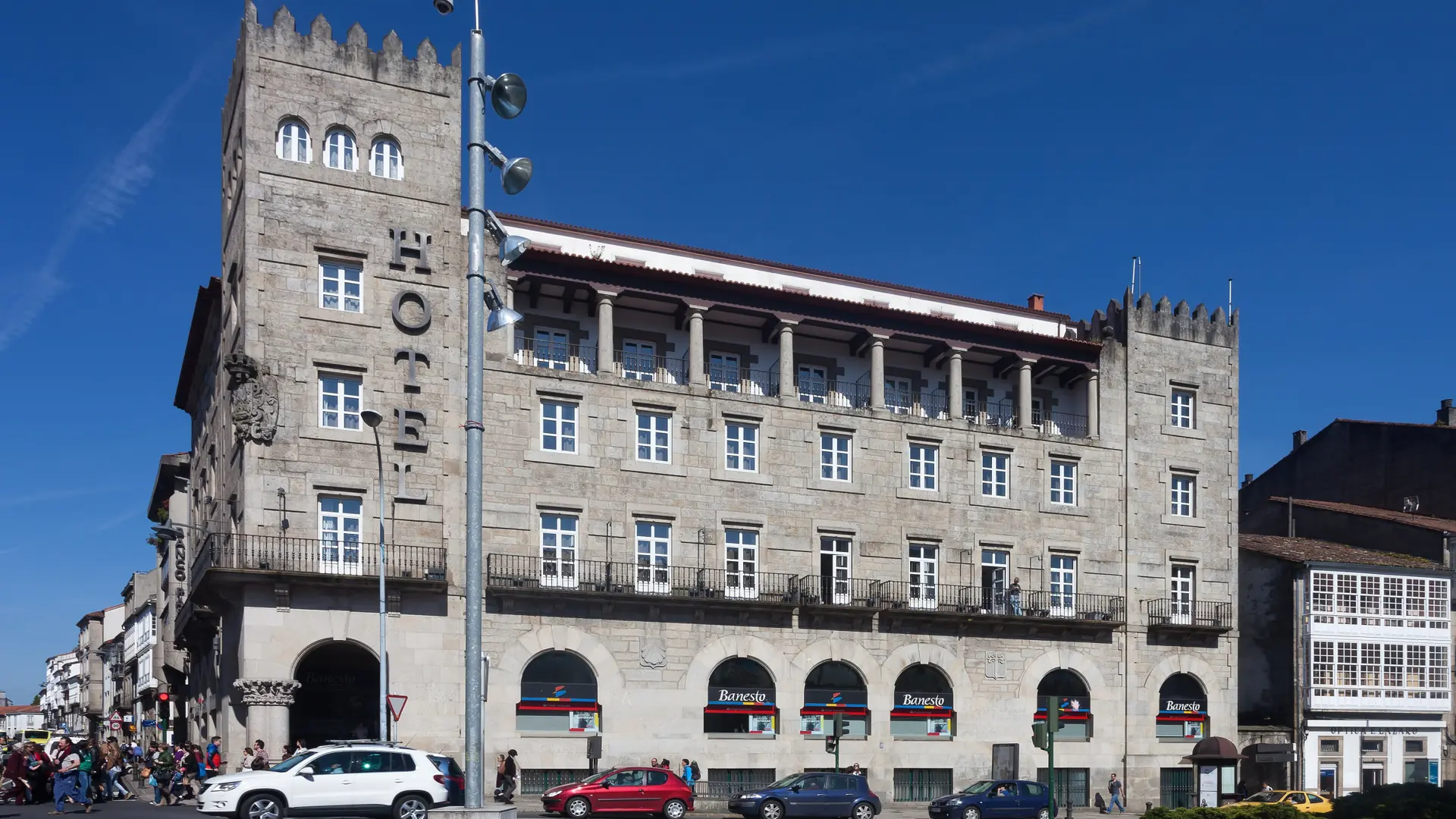
Santiago’s university history gives a city walk another focus alongside the pilgrimage. Colexio de Fonseca, near Obradoiro, was an early home of the university; farther east, the neoclassical building used by the Geography and History faculty shows a different stage of its architectural life. Looking at those buildings can make an outing about the city’s learning as well as its religious art.
At Mazarelos, the surviving arch is the remaining gateway from the medieval walls. Wine from Ribeiro and grain from Castile once entered here. It is a small exterior stop that connects the old centre with its history of goods and everyday movement, rather than another large interior to reserve.
Near the market, look at San Fiz de Solovio’s doorway. Its coloured Adoration of the Magi tympanum dates from 1316, while the tower and much of the present church are later Baroque work. Choose these exterior details for a shorter architectural circuit when a museum or Cathedral experience already has the main part of your day.
Cathedral squaresFour changing views
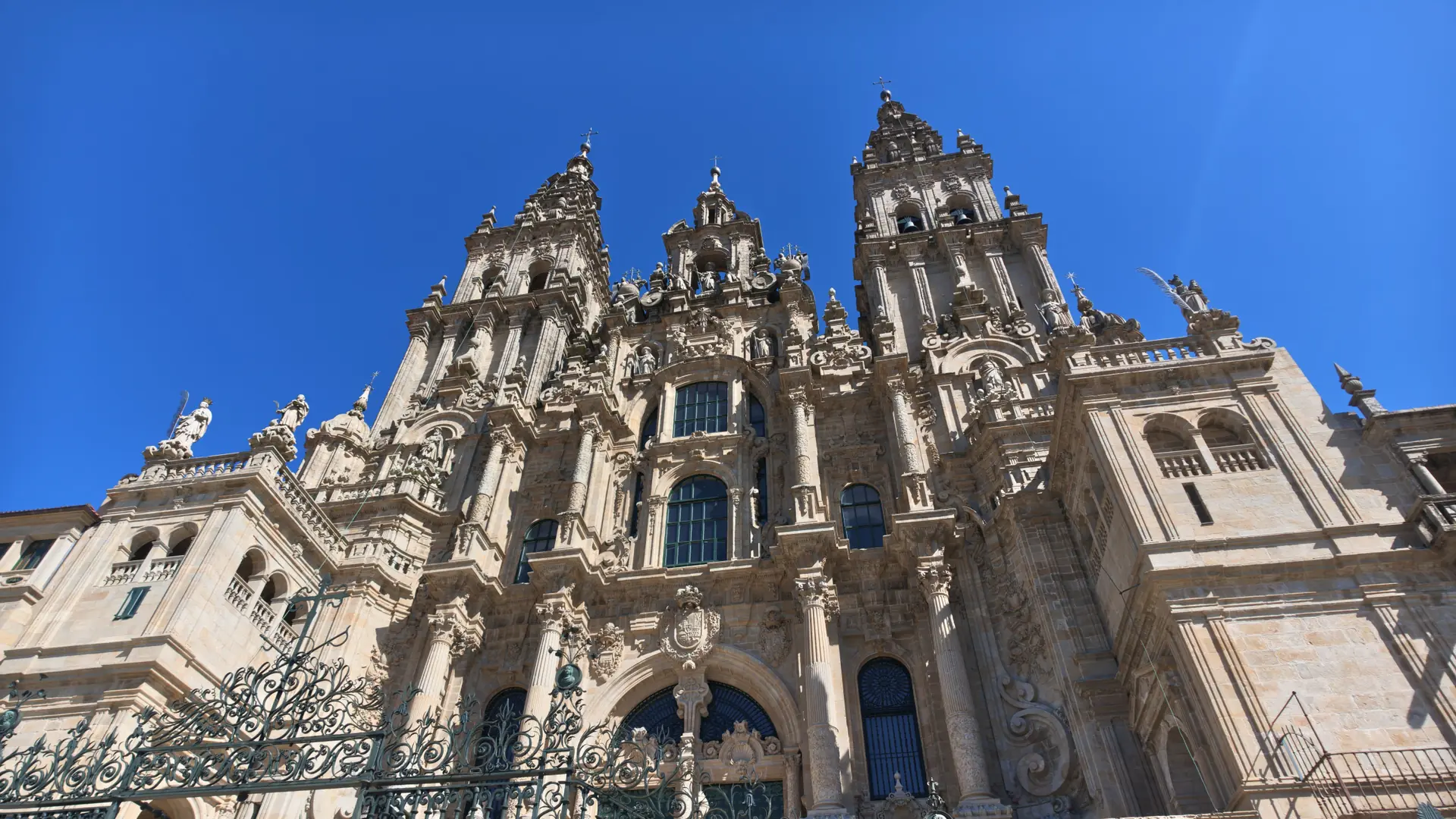
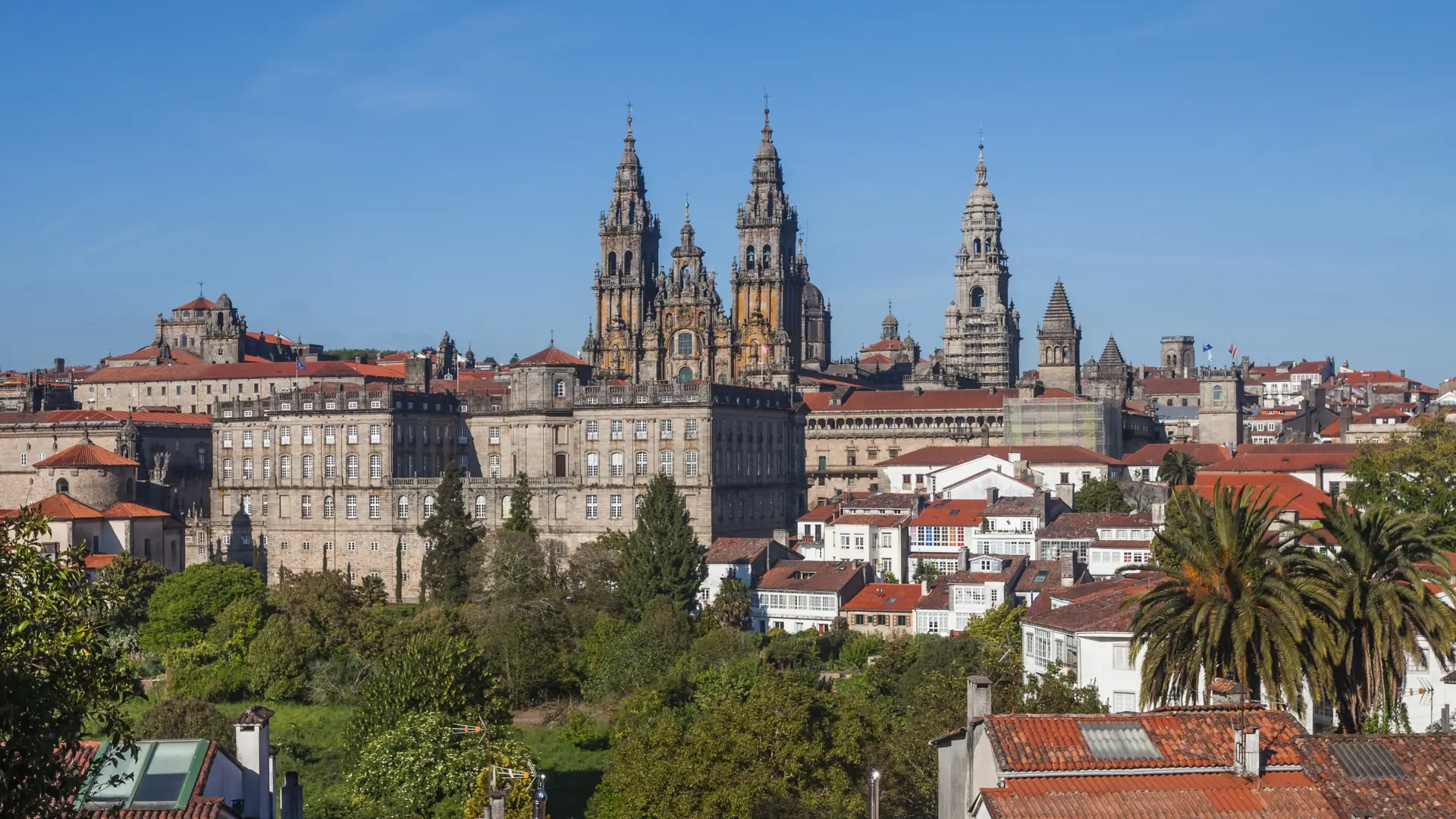
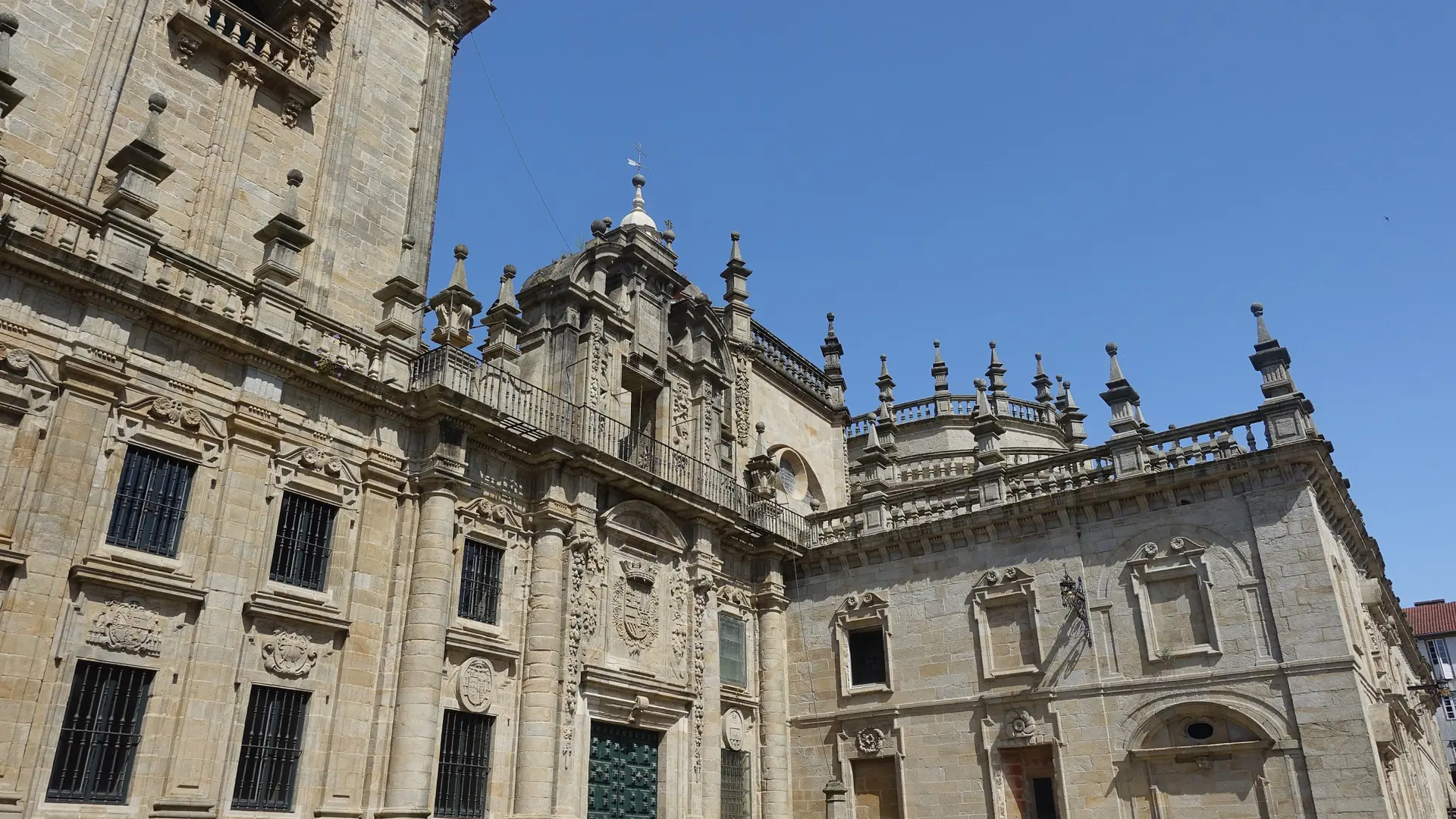
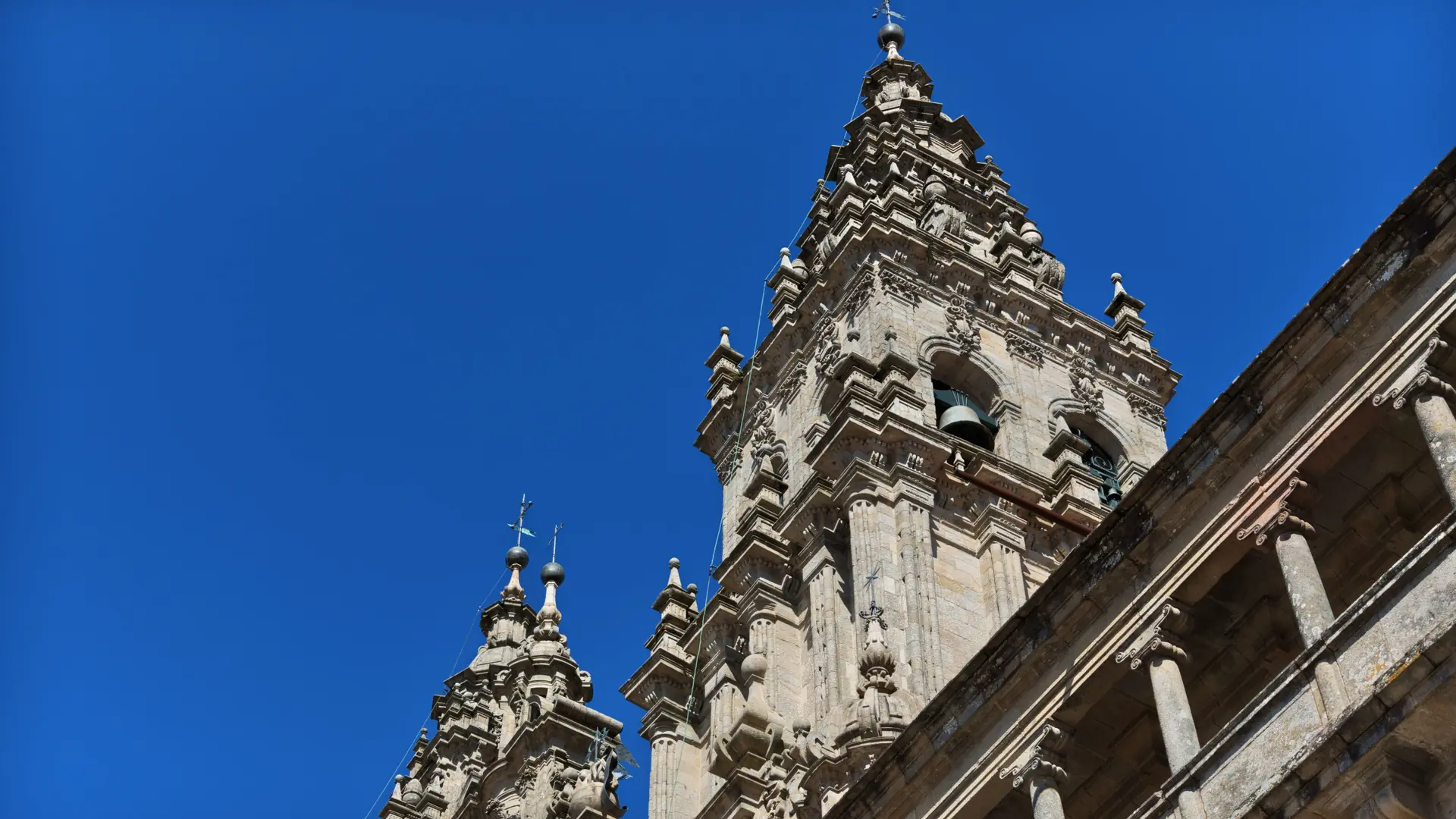
Circle the Cathedral for Obradoiro’s theatrical western façade, Quintana’s broad eastern square, Platerías and Inmaculada. Each side joins a different set of streets; allow an exterior circuit as well as a booked visit.
Parque da AlamedaA city portrait from the trees
Paseo da Ferradura frames the Cathedral towers through Alameda’s trees. Look for Las Dos Marías near an entrance, then use a bench or the oak grove for a pause between architectural stops.
Mercado de AbastosGalicia on the counters
Browse the market’s fish, shellfish and seasonal produce in the morning. For a meal, try pulpo á feira: octopus with oil, coarse salt and paprika, found on menus around Rúa do Franco. Restaurants have their own serving hours.
Museo do Pobo GalegoThe life behind the pilgrimage
The former San Domingos convent houses collections on Galician craft, work and traditions. See its triple helical staircase, then give the galleries time: their everyday subjects complement the pilgrimage monuments.
CGACContemporary art beside Bonaval
CGAC brings changing contemporary-art exhibitions to Bonaval. Check the current artists and themes, and compare Álvaro Siza’s building with the neighbouring former convent before entering the galleries.
Rúa Nova and Rúa do VilarDetails below the skyline
Look for coats of arms and iron balconies along the arcaded streets. Rúa Nova has theatre fronts and Santa María Salomé’s Romanesque doorway; O Toural adds a fountain and Pazo de Bendaña’s Atlas figure.
StartBooker answer
Which part of Santiago de Compostela makes a useful base for a first visit?
Choose Old Town for an architectural city break, Ensanche around Praza de Galicia for a station-side arrival, or San Pedro for the French Way approach and Bonaval’s museums. Vista Alegre offers a separate garden setting northwest of the centre. Two nights give you a full day beyond the Cathedral: market stalls, Galician collections and contemporary art. Book a particular Cathedral experience rather than assuming one ticket covers everything, and check which airport-bus service reaches your intended stop.
Historic streets
Rúa do Vilar and Rúa Nova have granite arcades, old town houses and distinctive architectural details.
Two cultural neighbours
Museo do Pobo Galego and CGAC sit beside Bonaval; Vista Alegre is a different park.
Different bus patterns
The direct 6A airport shuttle serves Hórreo at the Intermodal station; the stopping service also has central stops.
Things to do in Santiago de Compostela, Spain
Explore tours, attractions and local experiences in Santiago de Compostela, Spain.
Loading activities…
Activities provided by GetYourGuide. We may earn a commission on bookings.
AI-powered
Build a Santiago stay around your actual dates
Tell the planner your arrival service, departure time, walking limits and interests. Include the weekday: a market morning, a museum visit and a Cathedral reservation follow different calendars.
Use your email security code to continue planning.
After the walk, make room for rest
An Old Town room can give a Camino finish breathing space
Old Town
Old Town makes sense when you want the Cathedral squares and historic streets close to the room. After a Camino finish, that position also lets companions choose different short outings and meet again without another city crossing. Pick the exact street around the places you want to see, leaving time to rest between them.
•Rúa do Vilar and Rúa Nova offer an exterior architectural walk near the Cathedral quarter, useful when you want another outing without a timed reservation.
•The eastern old-town lanes lead towards the market, giving a morning’s shopping or food browsing a different purpose from the monumental squares.
Four settings for a Santiago stay
Old Town has monumental squares and arcaded lanes; Ensanche has the modern shopping streets and station approach. San Pedro brings the French Way and Bonaval into the stay, while Vista Alegre has its own garden setting. Use the exact address and room details to choose between properties within each area.
Old Town
Architecture and short breaks
The historic core gives you several different streetscapes within a small area: ceremonial squares, narrow shop lanes and covered walks. A room near O Toural has a different immediate setting from one facing Obradoiro. Use the exact street to picture your evenings, then compare properties on it.
Historic settingUrban walks
Ensanche
Train arrivals and everyday services
Ensanche is the modern commercial extension south of the old centre, with everyday shops and services rather than an exclusively monumental setting. Praza de Galicia is a useful reference point when comparing its northern addresses; a station-side booking farther south serves a different arrival pattern.
City neighbourhoodUrban walks
San Pedro
The French Way and Bonaval
This eastern approach lets you follow the French Way into the historic city. Bonaval adds another reason to stay on this side: the old convent, contemporary art centre and hillside garden occupy a different setting from the Cathedral squares. It suits a visitor who wants those places to be part of the stay.
City neighbourhoodGarden nearby
Vista Alegre
Garden architecture and longer visits
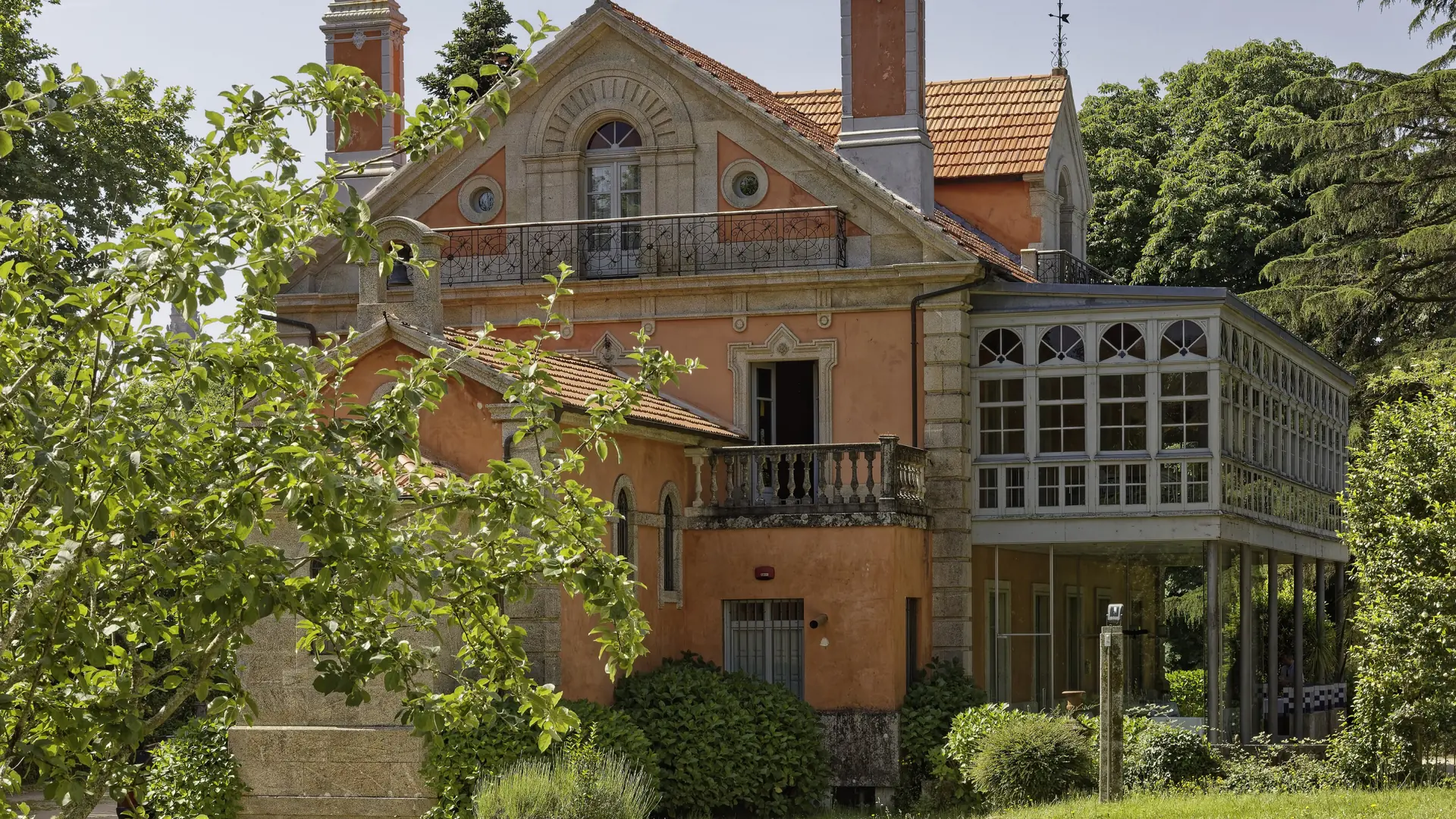
Vista Alegre, also known as Finca Simeón, brings together an older villa, established planting and contemporary university-related buildings. Casa Europa was restored as a residence for visiting academics. The park’s mix of styles makes this a worthwhile place to look around even if you sleep elsewhere.
City neighbourhoodGarden nearby
Compare the immediate setting
Area
Useful for
Features
Getting around
Old Town
Monuments, arcades and historic streets
Building access varies
Pedestrian lanes; confirm a vehicle drop point
Ensanche
Modern shops and the station approach
Northern and southern addresses differ
Hórreo links toward the Intermodal facilities
San Pedro
French Way approach and Bonaval
Garden terraces add gradients
Enter the old centre through Porta do Camiño
Vista Alegre
Finca Simeón’s garden and architecture
Separate from the eastern museum cluster
Plan the walk southeast towards the historic centre; the eastern museums are a separate outing.
Choose a visit you can actually fit into the calendar
A useful Santiago plan has room between its commitments. Pick a scenario, then adapt it to your dates and departure time. The weekday matters more than adding another attraction to a list.
Friday to Sunday: one full cultural day
Friday: arrive without a timed visit. Saturday: the market, then Pobo and CGAC on the Bonaval side after their 11:00 opening. Reserve a Sunday Cathedral visit only if departure leaves a margin.
Two nights after the Camino
Leave the finishing day open for Obradoiro and practical tasks. Next day, allow for the Pilgrim Office before a leisurely visit. A meal with walking companions can anchor the stay without another tight itinerary.
One night between trains
Use the arrival afternoon for historic streets and Cathedral exteriors; defer a ticketed visit if the connection is uncertain. Locate the actual rail entrance, rather than the coach-terminal doorway.
Three nights for gardens and architecture
Give Vista Alegre’s villa and newer buildings their own outing. Visit Bonaval’s former convent land, cemetery terraces and contemporary art on another day, with time to sit between walks.
Search Santiago de Compostela hotels
Once you know the area that fits your trip, compare live availability, exact hotel locations and room details. Editorial advice is separate from provider prices and availability.
Santiago-Rosalía de Castro Airport is outside the city. The Intermodal complex is a separate arrival point combining rail and coach facilities; the useful 6A stop at Hórreo is on the city side. Match the transport service to the stop, then the stop to your property.
Airport arrival
Direct 6A is not a tour of the central stops
The operator’s timetable dated 28 May 2026 distinguishes a direct airport shuttle from stopping services. Direct buses use Airport stop 321 and Hórreo (Intermodal) stop 691 only. Stopping buses coming from the airport also serve Virxe da Cerca at Praza de Abastos and Praza de Galicia. If your hotel is near one of those stops, check the service type before boarding rather than assuming every bus marked 6A follows the same pattern.
Read the airport timetable in the direction you travel
The first city departure is listed at 06:00 and the last airport departure at 00:30. Journey lengths vary by service: the 18:55 direct airport bus reaches Hórreo at 19:25, while the 19:00 stopping service reaches it at 19:45. Allow waiting time and the final walk as well. A late flight can miss the last bus; Aena lists taxis at the airport, but confirm the fare and permitted hotel drop point before relying on that alternative.
Moving between the city’s different parts
For a flight, use the departure stops rather than reversing the arrival map
Airport-bound stopping services use Ensinanza, Virxe da Cerca 10 and San Roque–La Salle before continuing outward. These are not simply the same stops used on arrival in the other direction. Most 6A services also have pick-up or drop-off restrictions within the city: use the urban network for an ordinary local hop rather than assuming the airport route doubles as a general city bus.
Know which part of the Intermodal complex you need
The coach station is on Rúa Clara Campoamor and forms part of the Daniel Castelao Intermodal complex. Tussa lists luggage lockers and assistance for passengers with reduced mobility there; the urban-bus connection at Hórreo is another reference point. Follow signage for your actual rail or coach departure and check its boarding arrangements, especially when connecting between the two.
Keep walking routes short enough to enjoy the city
Connect neighbouring places rather than repeatedly crossing town: the market and Bonaval form one eastern outing, while Alameda and the historic streets make another. Read the map’s slopes as well as its distances. In wet weather, footwear with grip and a slower pace help more than trying to maintain a timetable designed for dry paving.
Urban fares and the ordinary card
Four rides and ten rides lead to different choices
Tussa’s ordinary single is €1 (≈ US$1.12). In 2026, the ordinary card ride costs €0.36 (≈ US$0.40), with a refundable €3 (≈ US$3.37) deposit and reloads of 10, 20 or 30 rides. Buying a card with ten rides costs €6.60 (≈ US$7.41), against €10 (≈ US$11.23) for ten singles. If you need only four city rides, €4 (≈ US$4.49) in singles is cheaper upfront. Recovering the deposit requires returning the card in good condition.
Transfers have rules; the subsidy has an end date
Ordinary and youth card transfers are allowed between two different urban lines within 60 minutes. The monthly product runs for 30 calendar days from first use, which is different from buying a few rides for a weekend. The temporary 2026 discounts should not be assumed for a 2027 trip; check the operator again for your travel dates and ask about the appropriate card for each traveller.
Separate the street, the building and the experience
Ask for a route to the bedroom, not just an accessible district
The city authority describes access improvements in its heritage centre, but an individual property still needs checking. Request the entrance route, lift dimensions if relevant, any steps between lift and room, and the bathroom arrangement. For a cultural visit, CGAC documents ramps and lifts to most public spaces and an adapted toilet on the first floor; use the south covered-atrium entrance.
Cathedral visitor products have different physical requirements
The rooftop and Carraca Tower route climbs 140 internal steps and continues over stepped stone roofs; the operator does not admit wheelchairs on this guided experience. Pórtico wheelchair access can be restricted during liturgy, so contact the visitor office about your intended slot. A ticket for one route is not evidence that another route will meet the same access needs.
Costs, calendars and avoidable booking errors
October 2026 example for two adults over three days and two nights, using a historical room benchmark and explicit allowances. Rounded US dollars use the ECB rate of 19 October 2026, 1 EUR = US$1.1225. Excludes travel to the city apart from the airport bus, taxis, roof tours, laundry, insurance and shopping.
Weather and the current religious calendar
Treat the climate figures as historical context
AEMET’s 1981–2010 normals for Santiago airport, at 370 metres, give July an average daily maximum of 24.3°C and 43 mm of rain, against October’s 18.1°C and 226 mm. These are airport-station averages, not a forecast for your hotel street. They explain why waterproof layers can matter even on an otherwise mild trip; use the near-term forecast to place the outdoor parts of the day.
Use actual opening days for an indoor alternative
Museo do Pobo Galego opens Tuesday–Saturday 11:00–18:00 and Sundays or holidays 11:00–14:00; it is free on Sundays and 29 October, with last admission 15 minutes before closing. CGAC’s free exhibitions normally open Tuesday–Sunday 11:00–20:00, with galleries cleared shortly before closing. Both close on Mondays, with other holiday exceptions. These are useful choices for a rainy day only when your dates fit their calendars.
Check the October 2026 Mass relocation, not an older timetable
A Cathedral notice updated on 25 September says that from 16 October 2026, until further notice, the 09:30, 12:00 and 19:30 Pilgrim Masses move to San Agustín church near the market. The 07:30 Mass remains in the Cathedral’s Communion chapel, and ordinary Cathedral visits continue 07:00–21:00 outside services. Its liturgy page also says the Botafumeiro is temporarily out of operation for restoration; there is no confirmed restart date to build into a booking.
A complete two-night budget with separate assumptions
€610 (≈ US$685) for two adults, two nights
Allow €220 (≈ US$247) for one shared room over two nights. INE recorded an October 2025 city average of €97.95 (≈ US$109.95) per double room per night, before VAT and extra services, across categories and sales channels. Two nights with 10% hotel VAT come to about €215.49 (≈ US$242), rounded to the allowance. This historical benchmark does not quote a particular Old Town hotel or star category; compare current offers with the same breakfast and cancellation terms.
Meals, museum admissions and eight bus rides
Set a food allowance of €300 (≈ US$337): €50 (≈ US$56) per adult for each of three days, including breakfast and ordinary drinks. Add €48 (≈ US$53.88) for two standard Pórtico-plus-museum entries at €15 (≈ US$16.84), two paid-day Pobo entries at €5 (≈ US$5.61), and eight €1 (≈ US$1.12) urban-bus singles: four airport 6A journeys and four local rides. CGAC is free. Apply any admission eligibility or free-day saving to your own plan.
The levy and reserve, without double-counting
Allow €12 (≈ US$13.47) for the overnight levy, not a quoted invoice. A regular four-star hotel’s base is €2 (≈ US$2.25) per eligible adult per stay day or fraction, before VAT; categories differ and the cap is five stay days. The levy began on 1 October 2025. Confirm exemptions and the final tax-inclusive charge so you do not add a levy already in the room price. Add €30 (≈ US$34) for small extras. Room, food, tickets, levy allowance and reserve together make the headline total.
Is there a free way to see the Pórtico de la Gloria?
The Cathedral offers free timed Pórtico invitations, with advertised slots between 16:00 and 17:30 and a maximum of two per person. Reserve the separate invitation product; availability and closures apply, and it does not include the wider museum package. During your visit, look at Master Mateo’s carved ensemble, whose lintels were placed in 1188: Christ in Majesty fills the central tympanum, while twenty-four elders tune musical instruments in the arch above. The surviving painted surfaces reward a closer look within the permitted visiting time.
What does the roof-tour ticket include, and does the language affect the price?
The roof and Carraca Tower tour lists €15 (≈ US$16.84) standard and €12 (≈ US$13.47) reduced admission; the English-language tour costs €15 (≈ US$16.84) regardless of category. The guided route takes about an hour. Included permanent-museum, Gelmírez and MuSar visits can be made on the ticket day or during the following seven days, within their own opening hours. Check the package before paying for another museum ticket; a roof booking does not include the separate Pórtico visit.
Can I change a Cathedral booking if my journey is delayed?
The purchase policy does not allow exchanges or refunds for being unable to attend or making an error when buying. Entry is not allowed once the visit has begun. If the Cathedral cancels for force majeure or weather that endangers visitors, it offers a visit on another day as close as possible. Choose the slot with these conditions in mind, particularly when your arrival depends on a connection.
Can I take a suitcase or a large backpack into CGAC?
CGAC does not admit luggage, bags or backpacks larger than 30 × 30 cm into the building. It provides individual lockers in the auditorium anteroom, but that is not a promise of storage for a suitcase outside the admitted size. Leave larger bags elsewhere. Umbrellas and pointed walking sticks are also excluded from the exhibition rooms, so read the visitor rules before combining the museum with a travel day.
How does the Pilgrim Office queue work after a Camino finish?
The office at Rúa Carretas 33 is reached via García Sabell and Costa do Cristo from Obradoiro. It normally opens daily 09:00–19:00, except 25 December and 1 January. Take the QR queue ticket and use it to follow your position in real time. The office warns that heavy influx can prevent it from guaranteeing the Compostela on the same day; avoid a tight onward connection based on a guessed processing time.
Can visitors see CGAC’s terrace?
The museum lists Sunday terrace visits at 11:00, 12:00, 13:00 and 14:00, requested at reception. Ask there about access for that day rather than assuming the terrace is an unrestricted extension of the galleries. This can add a view of the building and its surroundings to an exhibition visit without making another cross-city journey.
What room arrangements help after finishing the Camino?
Ask about leaving bags before check-in, laundry facilities or a paid service, and somewhere to dry clothes. These services vary by property; confirm them instead of improvising over furniture. A private room may suit sleep and recovery better than continuing the communal rhythm of the trail. Keep an arrival afternoon free to eat, wash clothing and decide whether you want another walk. Companions can agree a central meeting point or dinner while taking different afternoons. Check lift access, reception hours and sound insulation in writing. The featured photo shows the Cathedral’s eastern façade on Quintana, not a hotel room.
How this guide was researched
Reviewed by StartBooker editorial teamTravel guide research and self-review
Last reviewed 2026-10-20
Updated
Editorial method: Editorial self-review of changed facts, language, real media and desktop/mobile output. Current Cathedral products and active liturgy notices, city transport fares, museum visitor information and the municipal levy were checked with responsible sources. The full budget distinguishes the historical INE room benchmark from chosen meal, levy and reserve allowances. Municipal food guidance and Cathedral art records add specific experiences; valid earlier research dates remain on unchanged claims.